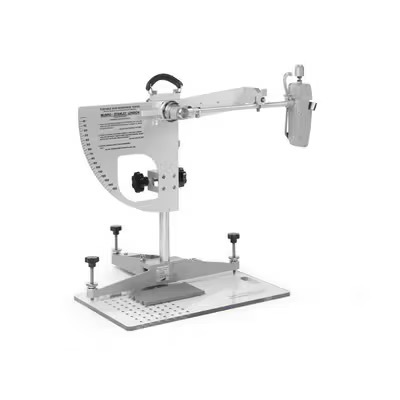
Pendulum slip testing, conducted in accordance with BS EN 16165:2021, is a robust and reliable method recognised by the Health and Safety Executive for accurately assessing the slip potential of various flooring types.
Testing can be performed for both:
- Barefoot
- Shod foot conditions
and is conducted in both wet and dry environments.
The methodology involves a swinging, imitation heel sweeping across a defined area of the flooring in a controlled manner. The friction properties of the flooring directly influence the resulting Pendulum Test Value (PTV). A total of 15 swings are conducted in three distinct directions (0 degrees, 45 degrees, and 90 degrees), and the average of these readings provides the overall PTV.
Upon obtaining the average PTV, the value is evaluated against the following scale to determine the floor’s slip potential:
- 24 and below: High Potential for Slip
- 25–35: Moderate Potential for Slip
- 36+: Low Potential for Slip
Our Slip Resistance Testing Service
We offer our trusted slip resistance testing service across a diverse range of locations and scenarios. Our fully mobile pendulum apparatus enables on-site slip testing for surfaces such as baths, shower trays, and floors.
Our team are able to carry out slip resistance testing to both British Standard Pendulum Slip Testing (BS EN 16165:2021) and European Testing – CE Marking – BS EN 14231
These services provide comprehensive results prior to the specification of tiles, offering peace of mind regarding the suitability and safety of the chosen materials.
We offer professional slip resistance testing using UKAS-calibrated pendulum equipment for both on-site and lab assessments. This industry-standard test accurately measures slip potential under wet and dry conditions, helping you identify potential hazards before accidents occur. A full report will be supplied after all testing has been carried out.
Should your flooring not meet the required traction standards, Non Slip 21 can be applied to enhance the floor’s grip, achieving a Pendulum Test Value (PTV) of 36 or higher.
Slip Resistance Testing FAQs
What is pendulum slip testing and how does it work?
Pendulum slip testing is the method recommended by the Health and Safety Executive (HSE) for assessing the slip potential of flooring surfaces. A swinging imitation heel sweeps across a defined area of the floor in a controlled manner, measuring how much friction the surface generates. The test is carried out in three directions (0°, 45°, and 90°), and 15 readings are taken in total. The average of these produces a Pendulum Test Value (PTV), which determines whether a floor presents a low, moderate, or high slip risk.
What does a PTV score mean?
The PTV (Pendulum Test Value) is the result produced by pendulum slip testing, and it tells you how slippery a surface is likely to be underfoot. A score of 24 or below indicates a high potential for slip; 25-35 is moderate; and 36 or above means the floor has a low slip potential and is generally considered safe. This is known as the PTV slip resistance rating and is the industry-standard benchmark used by health and safety professionals, insurers, and the HSE alike.
What standards does your slip resistance testing service follow?
Our slip resistance testing service is carried out in accordance with BS EN 16165:2021 (the current British Standard for pendulum testing) and BS EN 14231 for European CE marking assessments. All testing is conducted using UKAS-calibrated equipment, ensuring results are accurate, reliable, and fully recognised for use in insurance claims, health and safety audits, and legal risk assessments. Our team has years of industry experience and the trusted reputation to deliver.
Can testing be carried out on-site, or do surfaces need to come to a lab?
Both options are available: our fully mobile pendulum apparatus means we can carry out on-site testing across a wide range of locations and surface types, including commercial kitchens, swimming pools, baths, shower trays, and general floor areas. Lab-based assessments are also available for tiles and materials prior to installation.
Is your slip resistance testing service suitable before I specify new tiles?
Yes – it’s one of the most valuable times to use it. Having materials tested before specification means you can be confident in the safety and suitability of your chosen tiles before they’re installed. This is particularly useful for architects, specifiers, and contractors who need documented evidence of compliance as part of a project.
What happens if my floor fails the test?
If your flooring doesn’t achieve a PTV slip resistance rating of 36 or higher, we can apply our Non Slip 21 anti-slip treatment to enhance the surface grip. This brings the floor up to the required standard without the need for costly replacement, and is suitable for a wide range of flooring types including tiles, stone, and resin.
Who needs a slip resistance testing service?
Any property owner or manager with public-facing or high-footfall areas has a duty of care to ensure floors are safe. This includes commercial premises, schools, hospitals, leisure facilities, restaurants, and residential landlords. Commissioning a professional slip resistance testing service is one of the most straightforward ways to demonstrate compliance and reduce liability.
How do I book a test?
You can get in touch via the contact page at safetydirectgroup.com or call 01395 275583 to discuss your requirements and receive a quote.