A floor can look perfectly safe and still become dangerously slippery when wet or contaminated, which is why slip resistance should not be judged on appearance alone.
A pendulum test provides an objective way to measure the slip resistance of a floor surface by assessing how much grip it offers underfoot. The test produces a result known as a Pendulum Test Value (PTV), which indicates whether the surface has a low, moderate or high potential for slipping.
At Safety Direct Group, our pendulum slip resistance testing is carried out using UKAS-calibrated equipment and can be used to assess flooring in both wet and dry conditions. The test can help property owners, facilities teams, specifiers and health and safety professionals understand whether a floor is performing as expected and whether action may be required.
If you are looking for a broader introduction to floor safety, you can also read our complete guide to anti-slip flooring.
What Is a Pendulum Test?
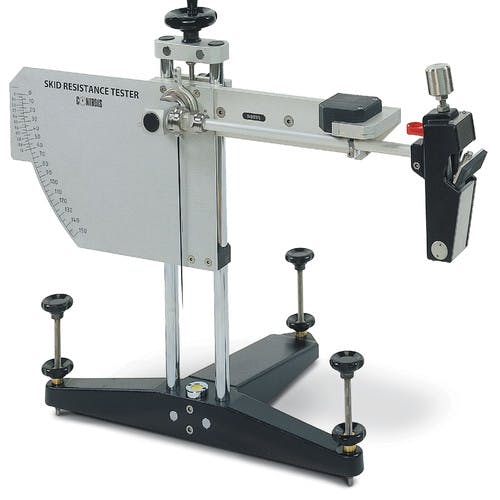
A pendulum test is a recognised method of measuring the slip resistance of a floor surface. The equipment uses a swinging arm fitted with a rubber slider designed to simulate the point at which a person’s heel makes contact with the floor. As the slider passes across the surface, friction slows the pendulum down. The amount of resistance is then converted into a numerical result known as the Pendulum Test Value. In simple terms, the more friction the surface creates, the higher the PTV.
As a general guide:
- 36 or above indicates low slip potential
- 25 to 35 indicates moderate slip potential
- 24 or below indicates high slip potential
A floor returning a PTV of 36 or more therefore presents a lower potential for slipping than a surface returning a score in the 20s. However, a PTV should always be considered alongside the environment in which the flooring is used. A floor that performs well when dry may behave very differently when exposed to water, grease, or another contaminant.
How Is a Pendulum Slip Test Carried Out?
The test is completed using specialist pendulum equipment positioned directly over the flooring surface.
The process broadly involves:
- Preparing and positioning the testing equipment correctly.
- Allowing the rubber slider to swing across a defined section of flooring.
- Taking readings from different directions across the surface.
- Repeating the test to obtain a representative result.
- Calculating the average PTV.
- Comparing that result against recognised slip-potential thresholds.
Our testing process uses a series of swings in three directions to build a representative picture of the floor’s performance. The equipment is mobile, meaning testing can be carried out on-site across a range of surfaces rather than requiring the flooring to be removed and sent away.
We carry out pendulum testing in accordance with BS EN 16165:2021, the current British Standard used for this type of slip resistance testing.
Why Is Flooring Tested in Different Directions?
Flooring does not necessarily provide the same level of grip in every direction. Factors including surface texture, patterns, joints, and the way a floor has been laid can all influence how it performs underfoot.
Testing in more than one direction therefore gives a more representative result than taking a single reading from a single point. We find this is particularly useful for textured flooring or surfaces with a directional pattern.
Should Slip Resistance Be Tested Wet or Dry?
The appropriate test conditions depend on how the floor is used in real life. As an example, a corridor that remains dry under normal conditions may need to be assessed differently from:
- a swimming pool surround
- a shower area
- a commercial kitchen
- an entrance exposed to rainwater
- a food production environment
- an external walkway
Where water or another contaminant is reasonably expected, testing the floor only when dry may not give a realistic indication of the actual risk. That is why professional slip testing can be carried out under relevant wet and dry conditions.
Baths and shower trays can’t be tested with a standard floor testing kit. Their curved, enclosed surfaces need specialist pendulum equipment, and only a handful of companies in the UK can do it. We already carry out bath slip resistance testing for some of the UK’s leading hotel chains. If a bath or shower falls short, our bath renovation and anti-slip surface treatments can bring it up to standard.
Why Is the Pendulum Test Used for Slip Resistance?
The main advantage of the pendulum test is that it gives an objective measurement of surface performance. Without testing, decisions are often based on assumptions such as never having an accident in that spot before or the assumption that textured tiles are automatically safer. However, neither of these assumptions tells you how much traction the surface actually provides
A pendulum test can instead help establish:
- How the floor currently performs
- Whether wet conditions materially change its performance
- Whether additional slip-control measures should be considered
- Whether a treatment has improved slip resistance
- Whether a newly installed material is suitable for the intended environment
This makes testing useful for both existing flooring and materials being considered before installation.
Who Might Need a Pendulum Slip Test?
Pendulum testing can be useful anywhere floor safety needs to be objectively assessed. This includes:
Commercial property owners and facilities managers
Testing can help identify potentially hazardous floors in entrances, corridors, kitchens, toilets and other frequently used areas.
Hotels and leisure facilities
Wet environments such as pools, spas, changing rooms and bathrooms require particular attention because water can significantly reduce surface traction.
Healthcare and care environments
Where people may have reduced mobility, understanding floor performance can form an important part of wider risk management.
Restaurants and commercial kitchens
Water, oils and food contaminants can all affect flooring differently from clean, dry conditions.
Architects and specifiers
A material can be tested before being specified or installed to help determine whether its slip resistance is appropriate for its intended use.
Businesses investigating a slippery floor (h3)
If staff or visitors are reporting that a particular area feels slippery, objective testing can establish whether there is a measurable problem.
What Happens If a Floor Has a Low PTV?
The first step is to understand why; often a poor result may relate to the flooring itself, contamination, cleaning practices, wear, or the environment in which the floor is being used.
Depending on the circumstances, possible actions could include:
- Reviewing cleaning and maintenance
- Addressing contamination
- Introducing temporary risk controls
- Improving the surface’s slip resistance
- Replacing unsuitable flooring where necessary
Usually, a low result does not automatically mean the entire floor needs replacing. For suitable surfaces, our NS21 anti-slip treatment can improve traction without installing a conventional coating over the floor. NS21 works by bonding with the existing surface at a microscopic level to increase grip while retaining its appearance.
You can read more about how anti-slip flooring works or explore NS21 anti-slip treatment.
Can You Test a Floor Before and After Anti-Slip Treatment?
Yes. This is one of the clearest ways to demonstrate whether a treatment has made a measurable difference. A test carried out before treatment establishes the existing PTV of the floor surface. It can then be treated and tested again to demonstrate its post-treatment performance.
For businesses responsible for staff, customers or members of the public, this also provides useful documentation rather than relying solely on a subjective assessment of whether the floor “feels” less slippery.
Pendulum Test vs R9, R10, R11 and R12 Slip Ratings
A PTV and an R rating are not directly interchangeable. You may also see terms such as R9, R10, R11 or R12 used for anti-slip flooring; however, these ratings come from a different method of slip resistance assessment and should not simply be treated as interchangeable with a PTV.
The key point is that a product’s quoted rating does not necessarily tell you how the floor will perform once installed, contaminated, worn, or cleaned in a real environment. Testing the actual surface in the conditions in which it is used provides a much clearer picture of its current performance.
This is why we offer on-site testing, so you can be sure how your flooring is performing in your environment. This can also be helpful for flooring that cannot be externally tested, such as swimming pools, baths or shower trays.
Book a Slip Resistance Test
If you are responsible for a floor that becomes slippery when wet, has been associated with slips or near misses, or simply needs its performance verified, professional testing can give you an objective answer.
Here at Safety Direct Group, we provide on-site and laboratory slip resistance testing using UKAS-calibrated pendulum equipment, with a written report provided following testing.
Book a slip resistance test or contact our friendly team to discuss your flooring.
Frequently Asked Questions
What is a pendulum test?
A pendulum test measures the slip resistance of a floor by passing a rubber slider across the surface and measuring the friction produced. The result is expressed as a Pendulum Test Value or PTV.
What does PTV stand for?
PTV stands for Pendulum Test Value. It is the numerical result obtained during pendulum slip testing.
What is a good PTV for flooring?
A PTV of 36 or above is generally regarded as indicating a low potential for slipping. Scores of 25–35 indicate moderate slip potential, while 24 or below indicates high slip potential.
How long does the anti slip treatment last?
Yes. Flooring can be tested in wet conditions, which reflects the environment in which the surface is normally used.
Does a PTV below 36 mean the floor has to be replaced?
Not necessarily. The cause of the poor result should be investigated first. Depending on the floor type and condition, cleaning, maintenance or a professional anti-slip treatment may improve its performance without replacement.