Slips, trips and falls are the single most common cause of workplace injury in the UK, and the majority are preventable.
In most cases, the floor is the problem – not the surface itself necessarily, but the condition it’s in, the environment it’s operating in, and whether appropriate action has been taken to manage the risk it presents.
This guide covers everything you need to know about anti-slip flooring: what it is, how it works, which surfaces are most at risk, what the law requires, and how we at Safety Direct Group can help you bring any floor up to a safe, compliant standard.
What Is Anti-Slip Flooring?
Anti-slip flooring is any floor surface (or any treatment applied to a floor surface) designed to reduce the likelihood of a person slipping underfoot. The term covers both purpose-built safety flooring manufactured with slip resistance built in, and treatments applied to existing floors to bring them up to the required standard.
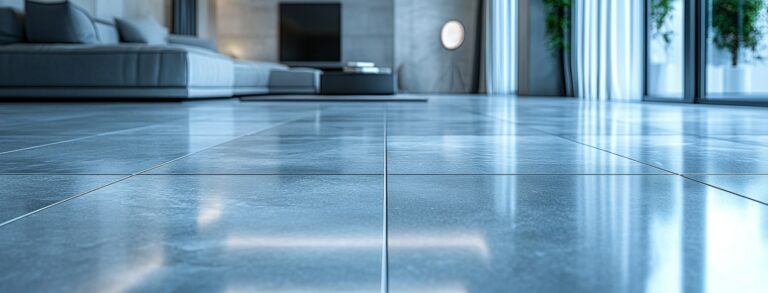
The key measure is friction. Slip resistance is quantified as a Pendulum Test Value (PTV), and in the UK the recommended minimum is 36 or above for a surface to be considered low risk. A PTV between 25 and 35 is classed as moderate risk. Anything below 25 is high risk and should be addressed as a matter of urgency. Standard glazed tiles, polished concrete, and smooth vinyl can all fall dangerously below this threshold in wet conditions – surfaces that look safe and feel fine when dry can become genuinely hazardous the moment moisture is introduced.
For a full explanation of what anti-slip flooring means and how the standards are structured, read our dedicated article: What is Anti-Slip Flooring? Everything You Need to Know
How Anti-Slip Flooring Works
Anti-slip flooring works by increasing the friction between a floor surface and the sole of a shoe, particularly in conditions where the floor is wet, oily, or otherwise contaminated. Different solutions achieve this in different ways.
Purpose-built safety flooring (such as the Altro range) incorporates textured or profiled surfaces at the point of manufacture, giving the floor a permanent structural grip that is rated to specific PTV thresholds. These products are engineered for specific environments and risk profiles, and the slip resistance is intrinsic to the product rather than applied after the fact.
Anti-slip floor treatments work differently. Rather than adding a visible coating or texture to the surface, advanced treatments such as NS21 from Safety Direct Group chemically bond with the floor at a microscopic level, forming a honeycomb-like structure that creates suction between the floor and a shoe sole when the surface becomes wet. The result is measurably improved grip with no visible change to the floor’s appearance: it looks and feels exactly the same, but performs to a significantly safer standard.
For a deeper look at the mechanism behind anti-slip treatments and how the science works, read our article: [How Anti-Slip Flooring Works](insert link to How Anti-Slip Flooring Works article)
The Legal Case for Anti-Slip Flooring
Floor safety is not a discretionary concern. UK law places a clear, enforceable duty on employers and premises owners to manage slip risks, and failure to do so carries serious consequences.
The primary legislative framework sits across the Health and Safety at Work Act 1974, which requires employers to ensure the health and safety of employees and visitors so far as is reasonably practicable, and the Workplace (Health, Safety and Welfare) Regulations 1992, which specify that floors must be suitable for purpose, maintained in good condition, and free from slip hazards.
In practice, this means that if a floor presents a measurable slip risk – particularly in a wet or contaminated environment – and no action has been taken to address it, an employer or premises owner is exposed. Enforcement action from the HSE, civil compensation claims, and reputational damage following a serious incident are all potential consequences of an unmanaged floor hazard. The HSE estimates that workplace slips and trips cost employers over £500 million annually in lost production, legal costs, and compensation.
The pendulum test is the instrument the HSE and courts use to establish whether a floor meets the required standard. A documented PTV reading, obtained by a qualified professional using UKAS-calibrated equipment, is the most reliable evidence of compliance available. If a floor has never been tested, or has not been tested since significant changes to its condition or use, that is a gap worth closing.
Our slip resistance testing service provides exactly that: a full written PTV report, carried out to BS EN 16165:2021, suitable for use in health and safety audits, insurance assessments, and legal proceedings.
Anti-Slip Flooring for Different Surfaces
Not every floor presents the same risk, and not every floor requires the same solution. The right approach to anti-slip flooring depends heavily on the surface material, its finish, the environment it’s operating in, and the type of contamination it’s regularly exposed to.
Ceramic and porcelain tiles are among the most commonly treated surfaces because their glazed finish offers almost no inherent grip once wet. Polished natural stone (marble, limestone, and granite particularly) presents a similar challenge in hotel lobbies, spa facilities, and heritage buildings where aesthetic considerations rule out replacement. Smooth vinyl and LVT, increasingly common in healthcare and education settings, can become hazardous in areas where liquid spillage is frequent. Timber and hardwood floors, polished concrete, and outdoor paving all have their own risk profiles and require tailored assessment before any treatment is specified.
NS21 is suitable for the majority of these surfaces. For external areas, our team at Safety Direct Group also offers a dedicated anti-slip decking treatment designed for timber and composite decking exposed to the weather. Where floor replacement is necessary or appropriate )particularly in high-risk commercial kitchen or healthcare environments) the Altro flooring range provides purpose-built safety flooring engineered to specific performance thresholds, installed by our team to manufacturer specification.
For a surface-by-surface breakdown of the right treatment for each flooring type, read: Anti-Slip Protection For Different Floor Tiles & Surfaces
Where Anti-Slip Flooring Matters Most
While anti-slip flooring is relevant in virtually any built environment, certain settings carry a concentrated and well-documented risk.
Commercial kitchens and food production
Grease, water, food residue, and high-pace working conditions make commercial kitchens one of the most hazardous environments for floor-related injury. The combination of wet floors and a workforce moving at pace under operational pressure means that even a moderate slip hazard becomes a serious one. Altro Stronghold 30, rated to PTV ≥55 and R12, is the standard specification for these environments. Our NS21 treatment is also suitable for kitchens where full floor replacement is not practical.
Swimming pools, changing rooms, and leisure facilities
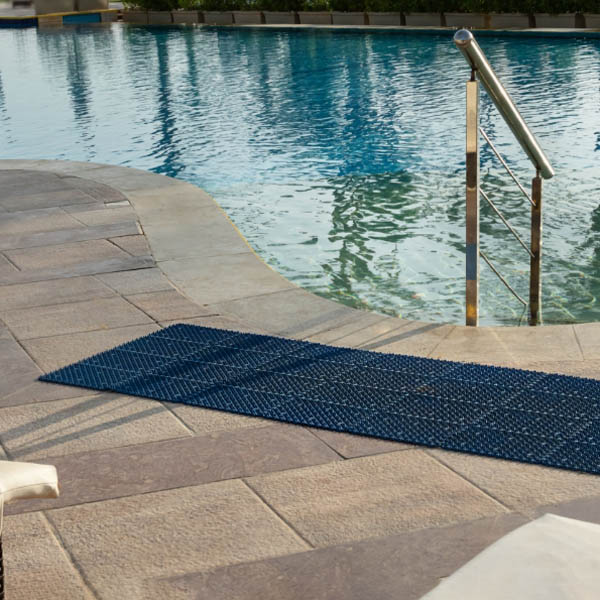
Poolside areas and changing rooms present a specific challenge: barefoot users on wet surfaces, often with no footwear providing any protective grip at all. Barefoot slip resistance is assessed to a different standard (DIN 51097, Class B or C) and requires specialist products. Altro Aquarius and NS21 are both proven solutions for these environments, and our team has extensive experience installing and treating floors in active leisure facilities. See our dedicated swimming pool flooring page for more detail.
Healthcare environments
Hospitals, care homes, GP surgeries, and dental practices require flooring that is not only slip-resistant but hygienic – capable of being cleaned to clinical standards without compromising the surface’s performance. Seamless installation with coved skirting is standard practice in healthcare settings, eliminating floor-to-wall junctions where bacteria can accumulate. We install Altro ContraX and other healthcare-grade safety flooring for NHS and private healthcare clients.
Bathrooms, wet rooms, and baths
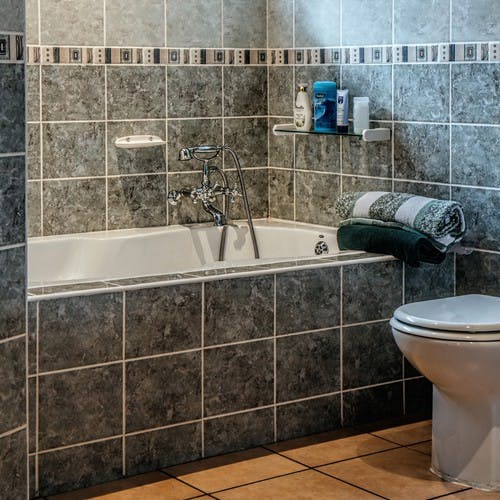
In both residential and commercial settings, baths and shower trays present a significant and often overlooked slip risk. Our bath and shower anti-slip treatment applies NS21 to the internal surfaces of baths, shower trays, and wet room floors – immediately improving grip without altering the appearance of the surface.
Entrance lobbies and high-footfall public areas
Rain, muddy footwear, and cleaning residues all conspire to make entrance areas one of the highest-risk zones in any commercial or public building. The practical challenge here is that the floor is often premium (polished stone, decorative tile, or sealed concrete) and aesthetics make surface change unacceptable. NS21 treats the surface invisibly, delivering the required PTV uplift without any visible modification.
Outdoor steps, decking, and external walkways
External surfaces face the harshest conditions of all. Algae, moss, rain, frost, and temperature fluctuation dramatically reduce grip, and the risk is compounded by the fact that outdoor falls often involve greater injury severity. Our anti-slip decking treatment and NS21 for external paving address this directly.
Anti-Slip Treatment vs. Purpose-Built Safety Flooring
These two approaches are not mutually exclusive, and the right choice depends on the circumstances of each project.
An anti-slip floor treatment (specifically NS21) is the appropriate solution when the floor is structurally sound and aesthetically acceptable, but not meeting the required PTV standard. It is fast, non-disruptive, invisible in result, and significantly less expensive than full replacement. For an existing commercial kitchen, entrance lobby, or swimming pool surround where the floor is otherwise in good condition, treatment is usually the most practical and cost-effective path to compliance.
Purpose-built safety flooring – the Altro range being the most widely specified in the UK – is the right choice when a floor is being replaced, when the current surface is worn or damaged beyond treatment, or when the environment demands a product rated to a specific performance threshold from the outset. Altro Stronghold 30’s 20-year guarantee and R12 classification make it the only defensible specification for a busy commercial kitchen. Altro Aquarius provides a barefoot slip resistance standard that a treatment alone cannot guarantee.
In many projects, both approaches are used alongside each other — new Altro flooring in the highest-risk areas, NS21 treatment in areas where the existing floor is performing adequately but needs a PTV uplift to achieve compliance across the whole site.
Our all flooring types page gives an overview of the range of surfaces we treat and install.
The Process: From Enquiry to Compliant Floor
Understanding what the process looks like from first contact to completed work helps set expectations and allows the right information to be gathered upfront.
The starting point is always an assessment of the floor. For straightforward enquiries (a single surface, clear floor type, known environment) this can often be completed based on photos and a brief description of the space. For larger or more complex projects, particularly where multiple floor types or risk profiles are involved, a site visit may be recommended before a quotation is issued.
Surface preparation is a non-negotiable part of any professional treatment or installation. Grease, cleaning product residue, old coatings, and contamination all affect adhesion and performance. Our team carries out the necessary preparation before any NS21 treatment or Altro flooring installation: it is built into the service rather than treated as an optional extra.
Once the work is complete, post-installation slip testing is available as part of a combined service to provide a documented PTV reading confirming the floor now meets the required standard. For clients in regulated sectors (healthcare, food production, education) we would strongly recommend including this as standard.
Costs depend on the size of the area, the floor type, the level of preparation required, site conditions, and access. A site-specific quote is always the most reliable way to understand the investment. For a full walkthrough of the process, the factors that affect pricing, and what a compliant quote should include, read: [Anti-Slip Floor Treatment Services: Costs & Getting a Quote](insert link to Costs article)
Maintaining an Anti-Slip Floor
Anti-slip flooring (whether treated with NS21 or laid as purpose-built safety vinyl) requires ongoing care to maintain its performance. This is not a concern unique to specialist surfaces; all flooring requires appropriate maintenance. But for slip-resistant floors, the consequences of getting it wrong are more significant.
The most common cause of reduced grip in a treated or safety floor is contamination build-up. Grease, soap residue, and hard water deposits can effectively fill the microscopic surface structure that provides traction, reducing the PTV of the floor over time. Poor cleaning routines – using the wrong products, failing to rinse properly, or applying floor dressings incompatible with the surface – are the most frequent culprit.
Safety Direct Group supplies a range of cleaning and maintenance products formulated specifically for use with NS21-treated floors. Using the right cleaning regime from the outset protects both the treatment and the compliance position of the floor. Following any treatment or installation, our team provides aftercare guidance tailored to the specific surface and environment.
How to Get a Compliant Floor: Next Steps
If you have read this far and are ready to take action, the process is straightforward.
If you are not certain whether your floor meets the required PTV standard, the right starting point is a professional slip resistance test. This gives you a documented baseline (a clear picture of where each area sits against the 36 PTV threshold) and informs the right treatment or installation decision for each surface.
If you already know your floor needs attention, get in touch with our team directly. We will assess the surface, recommend the appropriate treatment or installation, and provide a site-specific quotation covering preparation, treatment, and any post-installation testing required.
Our team at Safety Direct Group is based at Liverton Business Park in Exmouth, Devon, but we work with clients across the UK. Call us on 01395 275583 or contact us online to discuss your project.
Frequently Asked Questions
What is the difference between anti-slip flooring and an anti-slip treatment?
Anti-slip flooring is manufactured with slip resistance built in — the product is rated to a specific PTV at the point of production. An anti-slip treatment is applied to an existing floor surface to improve its slip resistance without replacing the floor. Both are valid approaches; the right choice depends on the condition of your existing floor, the environment it operates in, and the performance standard required. Our NS21 treatment is the most advanced anti-slip floor treatment available in the UK, and Altro safety flooring represents the gold standard in purpose-built safety vinyl.
What PTV score does my floor need to achieve?
The Health and Safety Executive recommends a minimum Pendulum Test Value (PTV) of 36 for a floor to be considered low risk in a shod environment. Floors used in barefoot environments — swimming pools, changing rooms, shower areas — are assessed to a different standard (DIN 51097), with Class B the minimum requirement for most wet barefoot situations. If you don’t know your floor’s current PTV, our slip resistance testing service will establish it.
Can anti-slip treatment be applied without closing the area?
In most cases, yes. NS21 treatment is applied without the need for lengthy drying times or the use of hazardous substances that require extended ventilation. The majority of treated floors are ready for use again immediately or within a very short period following application. We will confirm the specific requirements for your floor type and environment at the quotation stage.
Does anti-slip treatment change the appearance of my floor?
No. NS21 chemically bonds with the floor surface at a microscopic level — the change in surface structure is invisible to the eye and does not alter the appearance, colour, or texture of the floor. This makes it particularly suitable for decorative or premium surfaces where aesthetics matter.
How often does anti-slip treatment need to be reapplied?
This depends on foot traffic levels, the floor type, and the quality of the cleaning and maintenance regime in place. NS21 is designed to be durable under regular commercial use. Floors maintained with appropriate cleaning products and methods will retain their performance significantly longer. Our team will advise on expected longevity and maintenance requirements for your specific floor and environment.
Is anti-slip flooring a legal requirement?
Yes — not in the sense that a specific product is mandated, but in the sense that UK law requires floors to be safe, maintained in good condition, and free from foreseeable slip hazards. The Health and Safety at Work Act 1974 and the Workplace (Health, Safety and Welfare) Regulations 1992 both place this obligation on employers and premises owners. A floor that fails a pendulum test at below PTV 36 in a wet environment is a floor that presents a legally foreseeable risk — and one that has not been addressed.
Where do I start if I’m not sure what my floor needs?
The most straightforward starting point is a slip resistance test. This gives you objective data about your current position before any treatment decision is made. Alternatively, send us photos of the floor and a brief description of the environment and we can advise on the most appropriate next step. Get in touch here.
Explore More Guides
This pillar page is the starting point. Each of the articles below goes deeper into a specific aspect of anti-slip flooring:
What is Anti-Slip Flooring? Everything You Need to Know — a full explanation of what anti-slip flooring means, how PTV is measured, and what the compliance standards require.
How Anti-Slip Flooring Works — the science behind how anti-slip treatments and safety flooring generate grip, and how different methods compare.
Anti-Slip Protection For Different Floor Tiles & Surfaces — a surface-by-surface guide covering tiles, natural stone, timber, vinyl, concrete, and outdoor surfaces.